 First Steps
Mornings
Gripping the Nightstand Before You Stand: Why the First Steps of the Morning Hurt So Much
You wake up, swing your legs over the side of the bed and brace a hand on the nightstand before you trust your knees. The first steps are stiff and grinding, like bone on bone. Then, slowly, the day lets you move. If that is your morning, this page is for you.
By the First Steps Journal editorial team · Updated · 5 min read
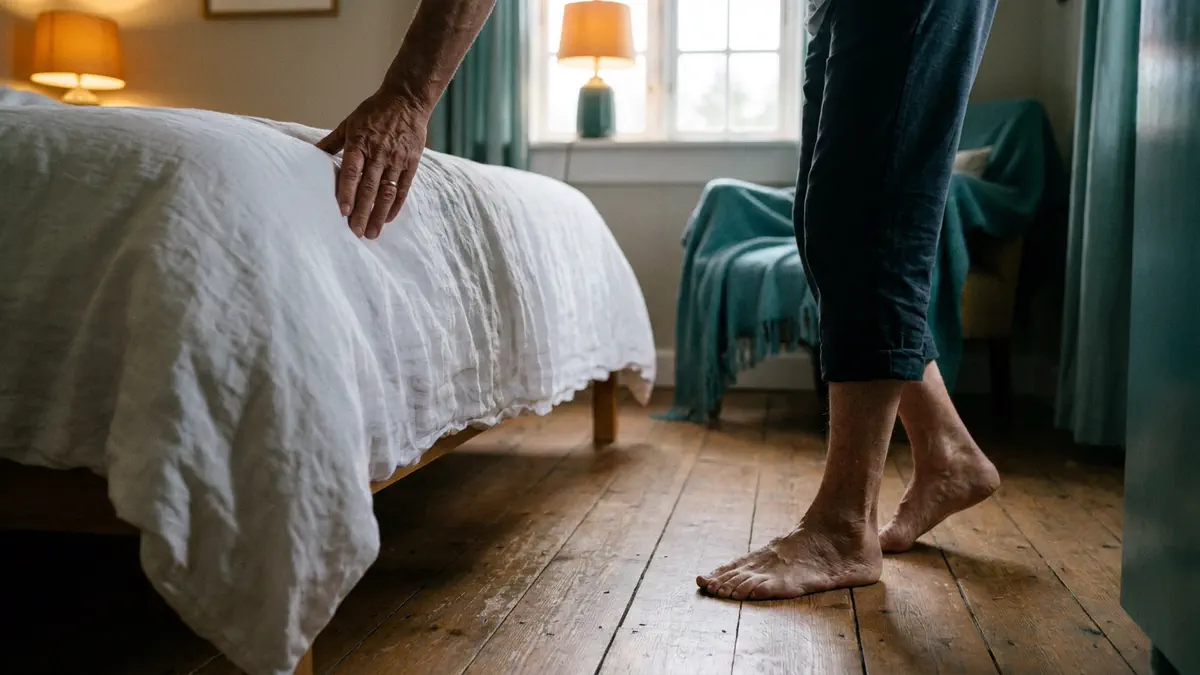
What those first steps feel like
You are awake before the alarm, and you already know what is coming. You lie still and take inventory: knees, hips, ankles, the small joints of your hands. Then you find the nightstand with one hand and push. The first steps are slow, the way a person walks on ice, and every one of them has to be negotiated.
By the time you reach the bathroom, something loosens. By breakfast you are almost yourself. But you have learned to plan around those first ten minutes. Nobody calls before nine. The coffee waits. The dog gets a short walk. Your wife has learned to listen for the creak of the bed and not to ask.
Why the morning is the hardest hour
Joints like to move. After seven or eight hours with little motion, they tend to feel stiffest at the exact moment you ask them to carry your weight again. That is why so many people past 60 describe the same pattern: the worst of it comes in the first steps, and it eases as the day warms them up.
Common does not mean small. When every morning starts with a struggle, the day starts on the back foot. You decide what you can manage before your feet have touched the floor. That quiet bargaining is a big part of what makes the stiffness so exhausting.
One practical note: a joint that is suddenly hot, red and swollen, or pain after a fall, deserves a call to the doctor the same day.
Small things that make the first minutes kinder
- Move before you stand. While you are still lying down, circle your ankles, flex and point your toes, and slowly bend and straighten each knee a few times.
- Take a minute at the bedside. Let your feet find the floor before you push up.
- Use warmth. A warm shower or a heated blanket on your side of the bed takes the edge off for many people.
- Light the path. A night light on the way to the bathroom means you never take a stiff step in the dark.
- Keep slippers within reach, so the first steps are never on a cold floor.
None of this fixes the problem, and it is not meant to. It makes the first minutes easier while you look for something that works on the reason mornings are hard in the first place.
“It’s just age” may not be the whole story
If you have ever raised morning stiffness with a doctor, you have probably heard that it comes with the years. That sentence explains when it shows up. It does not explain why the person across the street, the same age, never grips a nightstand.
The presentation behind ArtiBrex argues something different. Its villain is not the calendar. It is a toxin the presentation calls hidden, which it says keeps vitamins from being absorbed and sets off an overproduced enzyme it nicknames “acid for your joints,” plus a residue of what it calls inflammatory crystals. That is the presentation’s account, in its own words, and it is built to explain the one thing “it’s just age” never did: why the pills and creams left you right where you started.
How long does it last?
Pay attention to the clock for a few mornings. If the stiffness loosens after a few minutes of moving around, you are in the most common pattern. If it lingers through much of the morning, spreads to more joints, or is a little longer each season, write that down. It is the kind of detail that turns “it hurts” into something a person can act on.
And notice what you stop doing because of it. Maybe you no longer take the first walk with the dog, or you have started scheduling nothing before ten. Those small retreats are the real measure of what morning stiffness costs.

What a different morning looks like
Picture it plainly. Your feet hit the floor and your hand stays in your lap instead of gripping the nightstand. You walk to the kitchen at your own pace, shoulders back, and start the coffee while the house is still quiet. Nobody has to wait for you. That is the morning the presentation holds out, and it is a modest, reasonable thing to ask for.
Its answer is a simple morning ritual it calls the Japanese Cocktail, built around ginger from Okinawa, “the island where people forgot to die,” as the video puts it. ArtiBrex is that ritual in capsule form. The presentation says there is no diet to follow, no exercise to add and no painful treatment to endure, only a routine you can keep. It describes something noticeable early on and a fuller change over a few weeks. That timeline is the presentation’s own description, and individual results vary.
Frequently asked questions
Why are my joints so stiff when I wake up?
Joints that stay still for hours tend to feel stiffest when you first ask them to take your weight, and many people over 60 notice it. If the stiffness arrives suddenly, or a joint is hot, red and swollen, call your doctor.
How can I make the first steps out of bed easier?
Circle your ankles and bend your knees while still lying down, take a minute at the bedside, and use warmth before you walk. Small steps, but they take the sting out of the first minutes.
Is morning stiffness just part of getting older?
It is common with age, but the presentation behind ArtiBrex says age is not the real cause, and points instead to something hidden that stops vitamins from being absorbed.
What does the presentation say about a morning routine?
A short daily ritual it calls the Japanese Cocktail, which asks you to give up no foods and take on no exercise plan. ArtiBrex is the capsule form of it, taken as the label directs.
Keep reading
 Nights
Throbbing Joint Pain at Night: Why You Wake Up Five Times
Why joint pain seems louder after dark, what people try at three in the morning, and the night you would like back.4 min read Stairs
Knee Pain Going Down Stairs: Why You Take Them Sideways
Why knees protest going downstairs, the fear behind the sideways habit, and what steadier steps would feel like.5 min readThis article is general information, not medical advice, and it doesn’t replace a conversation with your doctor or pharmacist. Last updated November 12, 2026. Spotted an error? Write to support@artibrex.blog.